Capabilities
Multi-part questions
When one message asks for two different kinds of thing, such as mooring places and mobile-home pitches, GeoAI answers each kind on its own and combines the results into one answer.
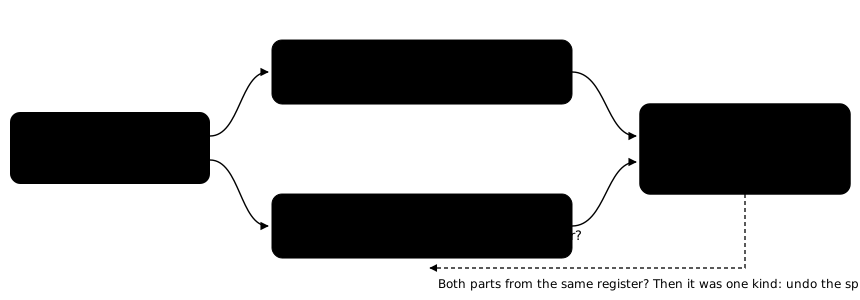
When a question is split
The only test is: how many different kinds of object does the question ask for? Conditions never cause a split, whether they are joined by and or or.
| Question | Split? | Why |
|---|---|---|
| Mooring places and mobile-home pitches in Aalsmeer | 2 parts | Two kinds of object, two registers. |
| Benches and waste bins in Elsrijk | 2 parts | Two kinds of object. |
| Trees within 5 m of a sewer and a road | 1 part | One kind, two conditions. |
| Wooden and stone bridges | 1 part | One kind in two categories. |
| Benches in Elsrijk or Randwijck | 1 part | One kind, two places. |
The detector is deliberately cautious: when in doubt, the question stays whole.
Each part stands on its own
Every part is written as a complete question that can be answered alone. A place, time or condition written once, at the start or end of the message, describes every kind, so it is carried into every part. Only when the message gives a kind its own place or condition does that kind keep it to itself.
| Question | Parts |
|---|---|
| Buildings from before 1920 and parks in Amstelveen | Buildings from before 1920 in Amstelveen · Parks in Amstelveen |
| Benches in Elsrijk and playgrounds in Aalsmeer | Benches in Elsrijk · Playgrounds in Aalsmeer |
| How many sheds, ponds and bridges are there in Zuidbos and Noordwijk | Three parts, each counted in Zuidbos and Noordwijk |
“Before 1920” belongs to the buildings only, because it is attached to them; “in Amstelveen” is written once at the end, so it applies to both kinds.
What you see
- The split is announced. “This question asks for 2 kinds of thing, answering each separately, then combining the results.”
- Each part runs. Its steps appear in the thinking panel as “Part 1: …”, “Part 2: …”.
- The results are combined. One step shows each part’s count and source register, then a single answer gives each figure with its own kind of object. The total is never presented as a count of one kind.
- One download. The combined file holds every part, and each feature is tagged with its part and source register.
When a part cannot be answered
The other parts are still answered. The refusal for the failed part is stated first, with its reason, so a partial answer is never presented as the whole answer. If no part can be answered, you get one message listing each part’s reason.
Guard against double counting. If every part turns out to come from the same register, the split was really one kind of object and adding the parts would count it twice. GeoAI undoes the split and answers the original question as one.
Current limitsParts run one after another by default, so a two-part question takes about twice as long. Questions where one part depends on another (“the district with the most trees, and how many playgrounds it has”) are not split yet.